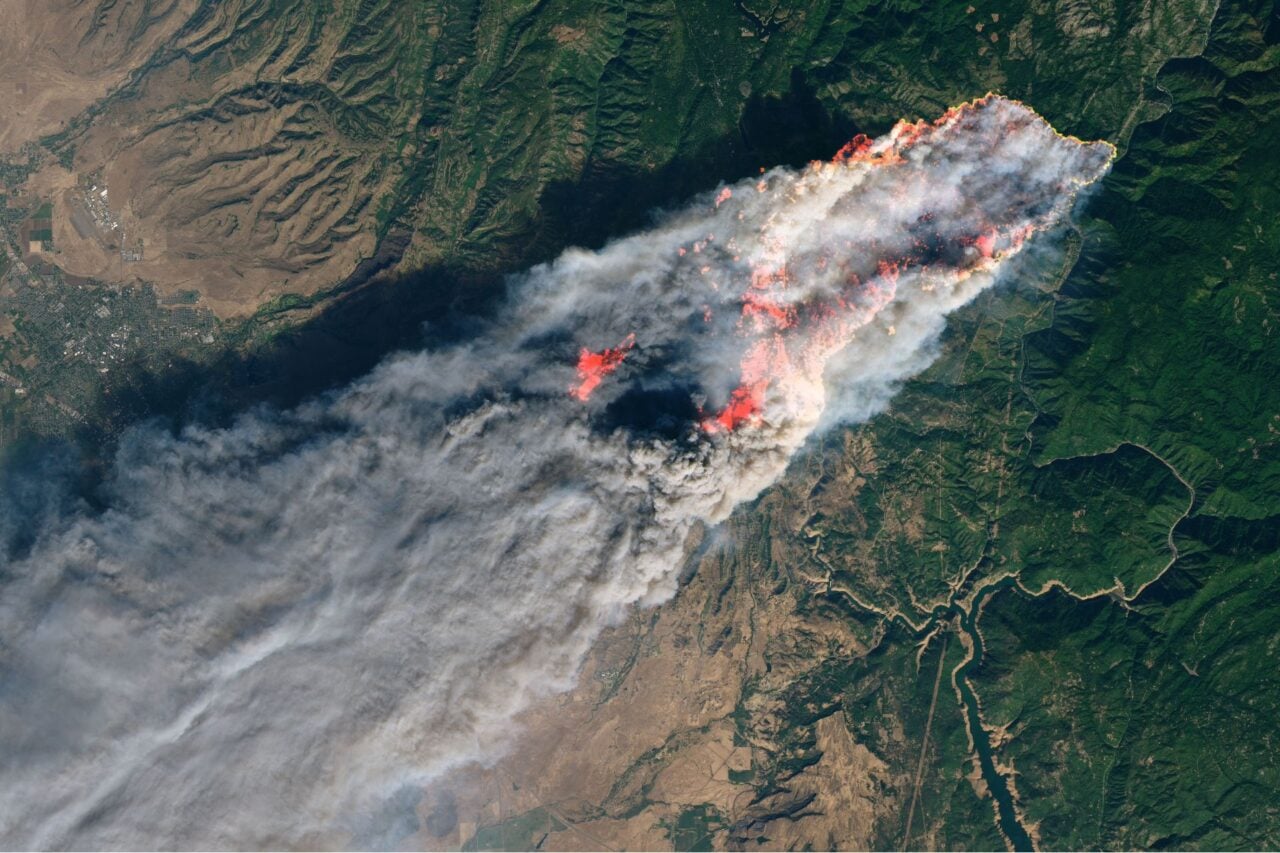
The U.S. wildfire season got off to a roaring start this year. By the end of June, more than 3 million acres had burned across the country, which is 157% of the previous 10-year average. Fortunately, wildfire responders are about to have a wealth of new data at their disposal.
California-based Muon Space has launched the first three operational satellites for Earth Fire Alliance’s (EFA) FireSat constellation. EFA bills FireSat as the first constellation designed specifically for wildfire detection, monitoring, and response. The three satellites launched from Vandenberg Space Force Base aboard SpaceX’s Transporter-17 mission on Tuesday. About two hours after deployment, Muon Space confirmed the satellites were healthy and had established contact with ground operators.
This launch was made possible by the success of the Protoflight mission, which sent a demonstration FireSat to orbit in March 2025. In October, the satellite identified a small roadside fire in Oregon that went undetected by existing space-based monitoring systems, validating its performance. The newly launched operational satellites will lay the foundation for the 50-FireSat constellation EFA and Muon Space hope to deploy by 2030.
“FireSat has already proven that a satellite built specifically for wildfire can detect fires earlier and smaller than was previously possible,” Jonny Dyer, CEO of Muon Space, said in a statement. “With these satellites, we turn that proof into an operational service—the start of dedicated coverage that fire managers can count on day after day.”
Sharper eyes in the sky
As Earth’s temperature rises, the U.S. wildfire season is growing longer and more intense, and this year is a clear example of how climate change primes the landscape for ignition. Record-low snowpack across the West and widespread drought conditions in the Southeast have parched much of the country. Brutal, expansive heatwaves are only making matters worse.
Several devastating fires broke out exceptionally early this year. In February, the Ranger Road fire scorched nearly 300,000 acres in Oklahoma and Kansas. Then, in March, the Morrill and Cottonwood fires together devoured more than 770,000 acres across Nebraska.
But even those massive blazes started with a single spark. The trouble is, traditional wildfire-monitoring satellites struggle to detect small fires, which makes it difficult for responders to catch them before they erupt into major disasters. FireSat is different. Each satellite is equipped with a six-channel multispectral infrared payload that can detect fires as small as 270 square feet (25 square meters) even through smoke and clouds, according to Muon Space.
The Protoflight mission already demonstrated FireSat’s unique capabilities. The small fire in Oregon was among over one million multispectral infrared images the demonstration satellite captured during its first year in orbit. If they deliver as promised, the three fully operational satellites launched last week will expand FireSat’s reach, observing every fire-prone region on Earth at least twice per day. Muon Space and EFA plan to accelerate this cadence as they expand the constellation, targeting hourly global revisit by 2029.
Small constellation, potentially big impact
Muon Space estimates that an hourly FireSat revisit rate could save the U.S. more than $1 billion in fire damage costs per year, protecting 3,500 homes and properties and reducing burned land by 2.3 million acres. What’s more, the company expects the constellation to prevent 21.9 million tons of carbon emissions from smoke, weakening the self-reinforcing relationship between wildfires and climate change.
These projections are exciting, and the success of the Protoflight mission suggests Muon Space and EFA have built a more effective and useful monitoring system. However, these three newly launched satellites will still need to prove themselves.
Joe Tyler, director of the California Department of Forestry and Fire Protection (CAL FIRE), is confident that they will. “The FireSat launch marks a transformative step toward space-enabled wildfire intelligence, strengthening California’s resilience and demonstrating the power of global collaboration in confronting increasingly complex fire years,” he said in a statement.