Windows 11 now runs on 78.8% of Windows devices after Microsoft ended support for Windows 10 on 14 October 2025, according to Lansweeper. Windows 10 still accounts for 16.9% of devices and no longer receives security updates, leaving newly discovered vulnerabilities unpatched.
“There’s a temporary bridge that we need to consider when looking at these numbers. Microsoft’s consumer Extended Security Updates program keeps eligible Windows 10 devices patched for one extra year, until October 12, 2027. But this is a paid extension, a temporary solution, not a destination, and it excludes most enterprise, LTSC, and domain-joined configurations,” Laura Libeer, Technical Content Copywriter at Lansweeper, said.
In the European Economic Area (EEA), eligible Windows 10 users can receive free ESU until 14 October 2026 without enabling Windows Backup or syncing settings, apps, or credentials to the cloud. Outside the EEA, consumers must pay for ESU, redeem Microsoft Rewards points, or enable Windows Backup to receive an additional year of security updates.
Windows 10 adoption remains high in some sectors
Many of the remaining devices either cannot or will not migrate to Windows 11. About 21.4% of Windows devices at SMBs still run Windows 10, compared with 16.6% at large organizations. Budget constraints continue to slow migration at smaller businesses, leaving some organizations on the unsupported operating system.
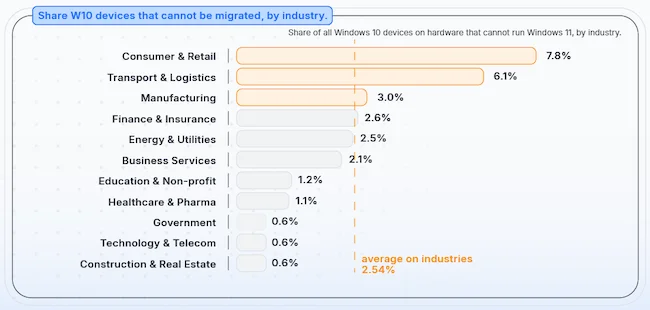
Share of all Windows 10 devices on hardware that cannot run Windows 11, by industry. (Source: Lansweeper)
Industries that rely on long-lived, certified, or embedded hardware have been the slowest to move away from Windows 10. Healthcare and pharmaceuticals have the highest share of Windows 10 devices, followed by consumer and retail, then manufacturing. Many of these systems are tied to specialized equipment, kiosks, and industrial devices that cannot be upgraded easily because of hardware limitations and vendor certification requirements.
Security and compliance risks
Windows 10 devices carry nearly three times as many active CVEs as Windows 11 systems, averaging 1,903 vulnerabilities per device compared with 652. Of those vulnerabilities, 66.6% are rated high or critical, while 2.4% are known to be actively exploited. Some Windows 10 Long-Term Servicing Channel (LTSC) editions remain supported under separate lifecycle policies.
Regulatory frameworks require organizations to keep systems on supported software or document and mitigate the risks associated with unsupported systems. Cyber insurers are also scrutinizing unsupported operating systems more closely. Organizations risk higher premiums, coverage exclusions, or denied claims if unsupported devices contribute to a security incident.
Support deadline nears
About 2.8% of Windows 10 systems do not meet Windows 11’s hardware requirements, making hardware replacement the only upgrade path. These devices are concentrated in consumer and retail, transport and logistics, and manufacturing, where specialized systems such as point-of-sale terminals, rugged handhelds, and embedded controllers are designed for long service lives and are often tied to specific hardware and software requirements.
Windows 10 is not the only unsupported operating system still in use. Including Windows 7, Windows 8.1, and Windows XP, 18.7% of Windows devices run an operating system that has reached end of support. Another 22.2% run versions that will reach end of support within the next six months, bringing the total share of unsupported or soon-to-be unsupported systems to 40.9%.
“The consumer Extended Security Updates that are holding much of the remaining Windows 10 base together expire on 12 October 2027. When it lapses, the devices that it is holding up do not migrate on their own. They will roll straight into the unsupported count. This means two in five Windows machines are either already out of support or about to be,” Libeer concluded.