Key takeaways
- Social media monitoring is the practice of tracking brand mentions, keywords, and conversations across social platforms to understand what people are saying about your brand, your competitors, and your industry.
- Monitoring helps teams catch reputation risks early, respond to customers faster, and surface insights that inform marketing, product, and sales decisions.
- AI-powered monitoring tools can now analyze sentiment, detect crises, and surface trends across millions of sources in real time.
- The best monitoring strategies share insights across the organization, not just the social team, and measure ROI tied to business outcomes.
Social media monitoring is the process of tracking what people are saying about your brand on social media.
This includes both tagged and untagged mentions, whether they show up in comments on your own accounts or in conversations happening elsewhere across the social web.
In practice, that scope is wider than most teams expect. Monitoring covers posts, comments, replies, reviews, video captions, forum threads, and news coverage across networks like Instagram, TikTok, LinkedIn, X, Facebook, YouTube, Reddit, and Bluesky, where 84% of U.S. adults use YouTube and 71% use Facebook. Most of those conversations never tag your handle, which is exactly why manual checking falls short.
How does social media monitoring work?
Social media monitoring isn’t just one activity. It’s a mix of signals that, together, tell you what people are saying about your brand, your competitors, and your industry.
Here are the key components that make up social media monitoring:
- Brand mentions: Track when people talk about your brand across comments, posts, and conversations. This is your baseline signal, and it covers both direct tags and untagged references.
- Sentiment analysis: Understand how people feel about your brand by looking at whether mentions are positive, negative, or neutral. Tracked over time, sentiment tells you whether perception is improving or slipping.
- Competitor analysis: Keep tabs on what people are saying about your competitors, including their campaigns, products, and gaps. Their weak spots are often your opportunities.
- Industry trends: Follow larger conversations in your industry, including trending topics, hashtags, and viral moments, so you can join them while they still matter.
- Influencer identification: Find people already talking about your brand who could become partners or advocates. Existing fans usually convert into partnerships faster than cold outreach.
- Share of voice (SOV): Measure how much of the conversation your brand owns compared to competitors. It’s one of the clearest ways to benchmark visibility.
- Crisis detection: Catch spikes in mentions or shifts in sentiment early, so you can respond before things escalate.
- Hashtag tracking: Monitor how your branded hashtags, campaign tags, and industry keywords are performing.
- AI-powered analysis: Use AI to cluster themes, flag anomalies, and summarize what thousands of mentions add up to, instead of reading them one by one.
Together, these signals turn everyday social conversations into actionable insights for your team.
The short answer: monitoring tracks individual conversations as they happen, and social listening analyzes those conversations in aggregate to find patterns. They’re closely related, but they serve different purposes.
- Social monitoring is reactive. It focuses on tracking mentions and responding to what’s happening in real time.
- Social listening is proactive. It starts by analyzing the information from social monitoring to spot larger patterns and trends. In other words, it looks at the bigger picture to improve your social media marketing strategy over time.
| Dimension | Social media monitoring | Social listening |
|---|---|---|
| Focus | Individual mentions and conversations | Aggregate patterns across conversations |
| Approach | Reactive | Proactive |
| Timeframe | Real time, hour to hour | Weeks, months, quarters |
| Primary use cases | Customer response, crisis detection, engagement | Strategy, campaign planning, product decisions |
| Example output | An alert about a complaint that needs a reply | A sentiment trend line showing perception shifting |
| Who uses it most | Social and customer care teams | Marketing leaders, brand, product teams |
For example, social media monitoring identifies comments about your brand online that could use an immediate response from your social or customer service teams.

Source: Warby Parker
Social media listening takes a step back and looks at those same comments over time to see how sentiment is changing.

Here’s how they work together in practice. Monitoring flags a cluster of complaints about a new checkout flow, and your care team responds the same day. Listening then shows that those complaints have doubled month over month, which is the evidence your product team needs to prioritize a fix. You need both: monitoring handles the moment, listening handles the pattern.
Social media monitoring helps brands stay informed, protect their reputation, and use real-time feedback to improve products, campaigns, and overall customer experience.
Let’s take a closer look at the top benefits of social media monitoring.
Understand your audience
It’s easy to track comments and mentions on your own posts. But there are also people talking about your brand without tagging you. If they’re part of the conversation, they’re part of your audience.
Social media monitoring gives you a more complete view of who’s talking about your brand (or your products) and what they have to say. That includes the people who would never fill out a survey or open a support ticket, but will happily post their opinion on Reddit.
Detect and manage crises early
By tracking mentions over time, you can establish a baseline for how people feel about your brand.
That makes it easier to spot when customer sentiment shifts, whether it’s a spike in negative comments or a customer complaint that has taken a life of its own.
For example, when headlines surfaced about Chipotle’s CEO allegedly targeting higher-income customers, the brand quickly responded across social media, including both tagged and untagged posts.

Source: Chipotle
Social media monitoring tools can help you track your share of voice and send real-time alerts when mention volume or sentiment moves outside its normal range. That early warning is often the difference between a contained issue and a news cycle.
But it’s not all about crisis management! Monitoring can also spot positive momentum. If a post is lighting up the digital airwaves, it might be the perfect opportunity to add some budget to a post.
Inform your marketing campaigns
Social media monitoring can gauge reactions to your social campaigns in real time. When you pay close attention, you can make adjustments on the fly.
It also surfaces useful insights, like common questions, concerns, or new product ideas or improvements.

Source: Starbucks
More broadly, monitoring can help you spot trends worth tapping into, from popular hashtags to memes that make sense for your brand.
And it’s not just about your own campaigns. Did a rival launch a successful campaign or jump on a trend that flopped? Seeing what works (and what doesn’t) can help you refine your approach and avoid repeating the same mistakes.
Understand your competitive space
Social media monitoring isn’t just about your brand. Competitor monitoring helps you keep an eye on conversations about your competitors and your industry as a whole. This makes it easier to benchmark performance and understand how your brand compares.
Monitoring can surface early signals, like:
- New product developments or launches
- Emerging features
- Major personnel or leadership changes
Plus, you can learn which reputation management strategies work best (and worst) for brands similar to yours.
Engage with your audience
When people tag your brand on social, they’re usually expecting a response, and usually fast. A monitoring plan helps you stay on top of those mentions, no matter how many platforms you’re managing.
But the real value goes beyond tagged posts. Monitoring also helps you find conversations where your brand isn’t directly mentioned.
Those moments can be the biggest opportunities to win over a frustrated customer or potential buyer. Or, to delight someone who’s already singing your praises.
AI has shifted monitoring from a task someone does to a system that runs continuously. Instead of scanning feeds and tagging mentions by hand, teams now review AI-generated summaries, anomalies, and themes, then decide what to act on.
Here’s where AI makes the biggest practical difference:
- Sentiment and emotion detection: Classifying tone at a scale no team could match manually.
- Anomaly detection: Flagging unusual spikes in volume or sentiment before a human would notice them.
- Theme clustering: Grouping thousands of mentions into a handful of recurring topics.
- Multi-language coverage: Reading and classifying conversations across markets without a translator in the loop.
- Visual recognition: Spotting your logo or product in images and video, even when nobody types your brand name.
- Automated summaries: Turning a week of raw mentions into a briefing your leadership team will actually read.
Inside Hootsuite Social OS, Lumen handles the insights and listening side of this work, while Wisdom lets you ask monitoring questions in plain language instead of building queries by hand.
AI-powered sentiment and intent analysis
Older sentiment tools sorted mentions into positive, negative, or neutral and stopped there. That was fine until someone posted “great, another outage.” Modern sentiment analysis models read context, so sarcasm, frustration, and genuine praise get scored differently.
Intent detection adds another layer. It separates a purchase question from a complaint from a general comment, which means your care team sees the messages that actually need a reply first. Because these models work across languages, a brand operating in a dozen markets can apply one consistent standard everywhere.
Automated crisis detection and real-time alerts
AI is very good at noticing when something looks different from normal. It learns your typical mention volume and sentiment range, then flags deviations the moment they appear, rather than when someone opens the dashboard.
That matters because social issues compound quickly. A complaint that gets 40 replies in an hour behaves nothing like one that gets 40 replies in a week. Automated crisis detection gives your team the window it needs to respond before a story sets.
Trend discovery and predictive insights
Beyond alerts, AI surfaces what’s building. It tracks hashtag momentum, emerging topics, and shifts in how people describe your category, often before those shifts show up in your own analytics.
Predictive models take it a step further by estimating whether a conversation is likely to keep growing or fade. That helps you decide where to spend budget and attention, instead of chasing every spike.
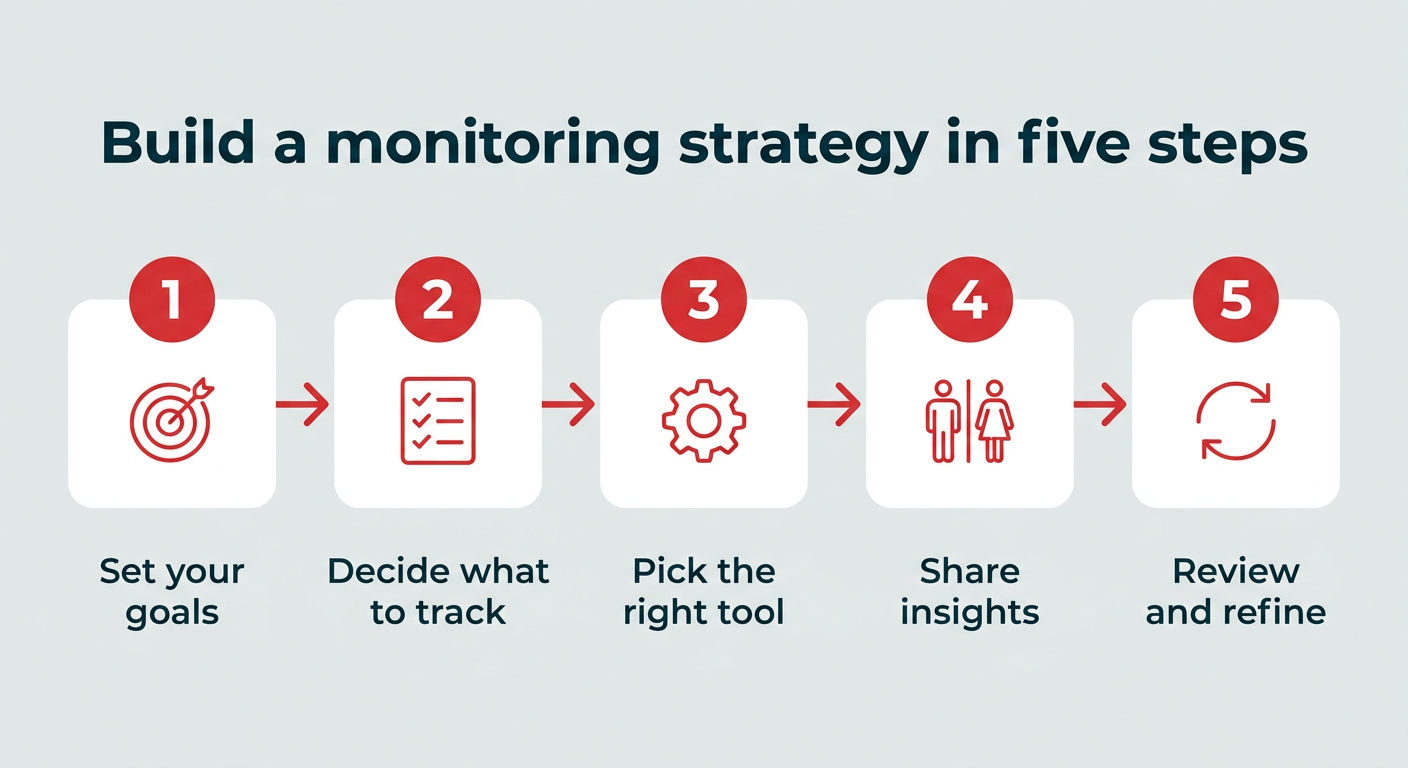
A social media monitoring strategy works best when it’s deliberate rather than ad hoc. Follow these steps:
- Set your goals
- Decide what to track
- Pick the right tool
- Share insights across teams
- Set a review cadence and refine over time
1. Set your goals
Start by defining what you want to learn from your social monitoring efforts.
A helpful approach is to think about the questions you want to answer through social media monitoring. Then, decide what social data you need to track to get those answers.
Common goals include:
- Understanding your brand reputation
- Monitoring competitors
- Identifying potential advocates or influencers
- Spotting opportunities for customer support and engagement
Where you can, tie those goals to business outcomes rather than social metrics alone. “Cut average first response time on complaints to under two hours” and “reduce support ticket volume by resolving issues on social” are easier to defend in a budget conversation than “increase mentions.”
For more ideas, check out our post on setting smart social media goals.
2. Decide what to track
Once your goals are clear, you can determine what to monitor (and where).
Here are some of the most valuable terms to track:
- Your brand name
- Your product names, including common misspellings
- Your competitors’ brand and product names, including common misspellings
- Your CEO’s name, along with other members of your leadership team
- Industry terms, keywords, and hashtags
- Branded hashtags
- Location-specific hashtags for bricks-and-mortar businesses
- Slogans or catchphrases
Start narrow. Brand monitoring works better when you begin with your brand name, top two competitors, and one or two industry keywords, then expand once you see what’s generating signal versus noise. Tracking 40 terms on day one usually just buries the ones that matter.
Pro tip 💡: If your audience spans more than one geographic territory, include multiple language variations of your keywords and hashtags.
3. Pick the right tool
You can monitor your social media manually, but it’s time-consuming. Without tools, you need to:
- Check mentions on each platform
- Search for specific keywords and hashtags
- Track competitor conversations
- Manually log everything in a spreadsheet
Most teams quickly outgrow this approach, which is where social media monitoring and social listening tools come in.
Social media monitoring tools automate this process, bringing all your data into one place. This allows you to analyze sentiment, track trends, and improve response times.
We cover the landscape in more detail in the tools section below, and there’s a full breakdown in our dedicated guide.
4. Share insights across teams
Social media monitoring is most valuable when insights travel beyond the social team. Cross-team insights are what turn monitoring from a reporting exercise into a business input.
Start by looping in your social and customer service teams, who can act quickly on mentions, questions, and customer feedback.
According to Perakakis, Mastorakis, and Kopanakis (Social Media Monitoring: An Innovative Intelligent Approach, 2019), “Social media monitoring tools can help marketers identify opportunities for interacting with customers by providing vital insights… determining when and how to respond back to customers.”
From there, expand to:
- Marketing teams, to refine overall strategy and messaging
- Sales teams, to understand customer needs and objections
- Product teams, to identify opportunities and improvements
The simplest version of this is a short recurring digest: three themes, one risk, one opportunity, sent to the teams that can act on each.
5. Set a review cadence and refine over time
Monitoring fails quietly when nobody looks at it. A cadence keeps that from happening.
- Daily: Review mentions that need a reply and check any alerts that fired.
- Weekly: Scan sentiment trends, share of voice, and competitor activity.
- Monthly or quarterly: Report to leadership, then audit your keywords and filters.
That last step matters more than it sounds. Products get renamed, competitors enter the market, and new platforms pick up traction. Keywords that were useful six months ago can go quiet while new ones go unmonitored. Reviewing your setup on a schedule keeps your monitoring aligned with what your brand actually looks like today.
Social media monitoring tools to know in 2026
Most social media monitoring tools fall into one of three buckets: native platform tools, all-in-one social management platforms, and dedicated enterprise listening suites. Which one fits depends on how many brands, markets, and teams you’re supporting.
- Hootsuite Social OS: Combines monitoring, publishing, engagement, and analytics in one connected system, with Lumen handling AI-powered insights and listening across social and web sources. Plans start at $99 per user per month for Standard and $249 per user per month for Advanced, with enterprise listening available on custom Enterprise plans.
- Native platform tools: Free, built into each network, and useful for basic mention tracking. The tradeoff is that you’re checking every platform separately with no unified view or historical sentiment data.
- Dedicated listening suites: Deep coverage across news, forums, and review sites, usually priced for large enterprises. Strong on data breadth, but they typically sit outside your publishing and engagement workflow.
- Review and reputation tools: Focused on Google, Yelp, and app store reviews rather than social conversation. Often a useful complement to social monitoring rather than a replacement.
Hootsuite Social OS brings monitoring, engagement, and analytics into one place, so the conversation you spot is the conversation you can respond to without switching tools. Here’s how the pieces fit together.
Track mentions and keywords across platforms
In your Hootsuite dashboard, you can set up streams to monitor social media mentions, keywords, and hashtags for multiple social networks.
Streams are organized into customizable boards, so you can structure your monitoring setup in a way that works for your team. For example, you might create:
- One board per platform
- One board for brand mentions
- Another for competitors or industry keywords
Setting up a stream is simple. Select your platform and social media account, then choose what you want to track.
Mentions that need a reply can be routed straight into Nest, where your care team handles incoming conversations in a shared inbox rather than chasing them across platforms.
Analyze competitors with Hootsuite Analytics
If competitive monitoring is a priority, Hootsuite Analytics helps you go beyond surface-level tracking.
Start by adding your top competitors (up to five at a time on Standard plans, and up to 20 at a time on Advanced and Enterprise). From there, you can create a competitive analysis report that shows:
- Top- and lowest-performing posts
- How competitor performance compares to yours
- What types of social media content are driving the most engagement (for you and your competitors)
This makes it easy to benchmark performance and identify opportunities to refine your strategy.
You’ll also get insights into which hashtags are working best for your competitors, based on engagement metrics like comments, likes, and shares.
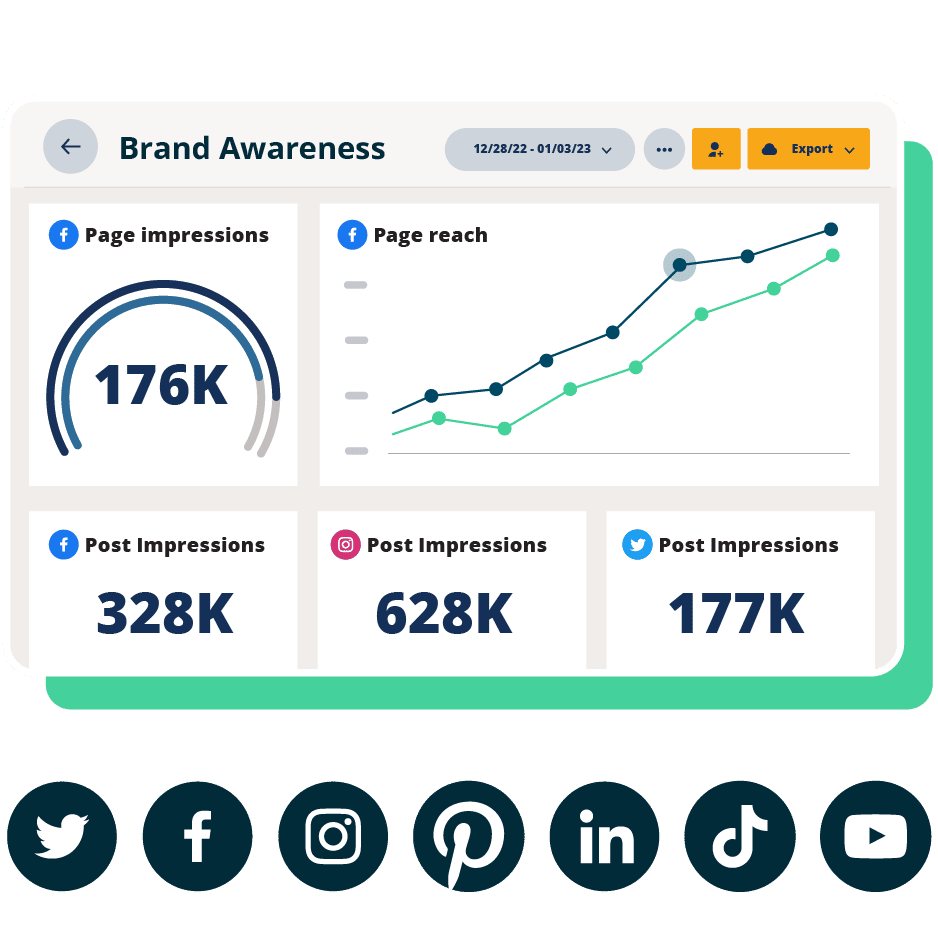
#1 Analytics Tool for Growth
Beautiful reports. Clear data. Actionable insights to help you grow faster.
Get deeper insights with Lumen
Lumen is the integrated insights and listening app inside Hootsuite Social OS, built for teams that need to see beyond their own channels.
Lumen helps you understand what people are saying about your brand across a wide range of sources, including blogs, forums, and news sites, with insights powered by artificial intelligence.
It pulls data from over 150 million sources, including emerging platforms like Bluesky. You can categorize conversations with filters, apply AI-powered sentiment and theme detection, and assign items to the relevant team members for follow-up.
Most monitoring programs stall for predictable reasons. Knowing them upfront saves a lot of rework.
- Data overload: Broad keywords generate thousands of irrelevant mentions. Tighten your queries with exclusions and Boolean logic, and start with fewer terms than you think you need.
- Separating signal from noise: Not every mention deserves attention. Use sentiment and intent filters to surface the conversations that need a response, and let the rest roll into trend reporting.
- Monitoring across languages and regions: A single English keyword set misses most of what’s said in your other markets. Build local keyword variations and rely on multi-language sentiment models rather than translation after the fact.
- Proving value to leadership: Mention counts don’t sell a budget. Tie monitoring to response times, avoided escalations, and product or campaign decisions it influenced.
- Keeping up with new platforms: Audiences move. Audit your source coverage quarterly so emerging networks and forums don’t become blind spots.
None of these are permanent problems, but they all get worse if you leave your setup untouched for a year.
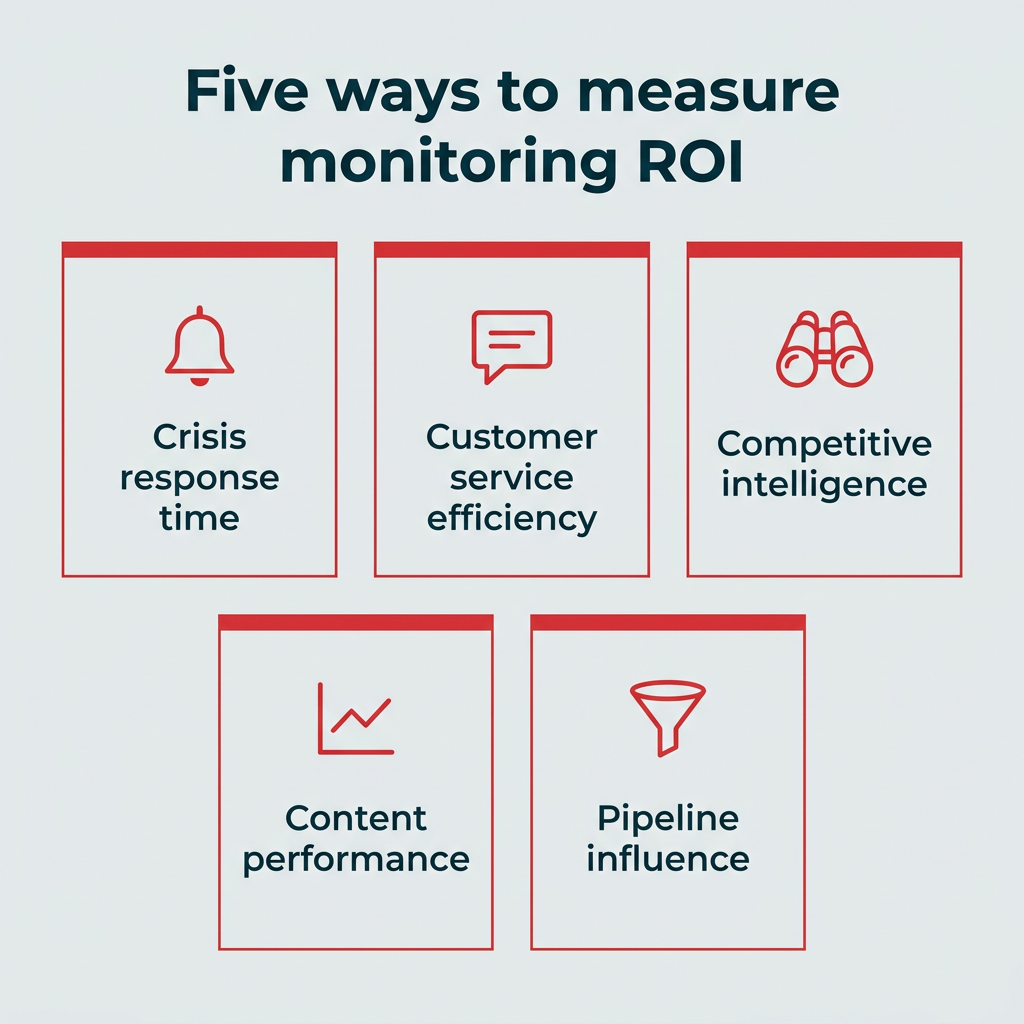
Measuring social media monitoring ROI means connecting what you track to outcomes your leadership team already cares about. Here’s how to frame it:
- Crisis response time: Track how quickly you detect and respond to negative sentiment spikes. Faster detection reduces the reach of an issue, and that’s the clearest cost avoidance story you have.
- Customer service efficiency: Measure first response time and resolution rate on social. Issues resolved in a public thread often deflect tickets from support channels entirely.
- Competitive intelligence value: Log the decisions monitoring informed, such as a repositioned campaign or a launch timing change. Attach a value to each one, even a rough estimate.
- Content and campaign performance: Compare results for content built on monitoring insights against content that wasn’t. Improvements in engagement or conversion are directly attributable.
- Pipeline influence: Track qualified conversations sourced from monitored keywords, then follow them through to opportunity and revenue in your CRM.
Pick two or three of these rather than all five. A short, consistently reported set of metrics is far more persuasive than a dashboard nobody reads.
FAQ: Social media monitoring
What is social media monitoring and how does it work for businesses?
Social media monitoring is the process of tracking what people are saying about your brand across social media platforms. It works by using a monitoring tool to collect mentions in real time based on specific keywords, then applying AI to score sentiment and cluster themes. Teams review those conversations, respond where needed, and track patterns over time.
How do companies use social media monitoring to track brand mentions and sentiment?
Companies use social media monitoring to track brand mentions and understand how people feel about their brand. AI-powered sentiment tools classify each mention as positive, negative, or neutral, and can pick up on sarcasm and intent that older keyword-based tools missed. Analyzing that data over time gives teams a reliable baseline of brand perception.
What are the best social media monitoring tools for enterprise teams?
The best social media monitoring tools for enterprise teams combine broad source coverage with the ability to act on what you find. Hootsuite Social OS pairs monitoring with publishing, engagement, and analytics, and includes Lumen for AI-powered insights and listening. Native platform tools and dedicated listening suites are common complements, depending on how many markets and brands you manage.
How does social media monitoring differ from social listening?
Social media monitoring differs from social listening in scope and purpose. Monitoring is reactive and tracks individual mentions so you can respond in real time. Listening is proactive and analyzes those same conversations in aggregate to identify sentiment trends, emerging topics, and long-term strategy implications.
How can businesses use social media monitoring to manage risk and reputation?
Businesses use social media monitoring to manage risk and reputation by spotting issues before they escalate. Real-time alerts flag unusual spikes in mention volume or sudden shifts in sentiment, giving teams time to respond. Monitoring also reinforces positive sentiment by helping brands engage with happy customers and amplify good feedback.
What should you track in social media monitoring?
In social media monitoring, you should track your brand name, product names, competitor names, industry keywords, branded hashtags, and key personnel mentions across all relevant platforms. Include common misspellings and language variations for each market you operate in. Start with a narrow list and expand once you see which terms produce useful signal.
How much does social media monitoring cost?
Social media monitoring costs range from free to several thousand dollars per month depending on coverage and scale. Native platform tools cost nothing but offer limited functionality. Hootsuite plans start at $99 per user per month for the Standard plan and $249 per user per month for the Advanced plan, with enterprise listening available on custom Enterprise pricing.
Can social media monitoring help with customer service?
Yes, social media monitoring directly supports customer service by surfacing customer questions, complaints, and feedback in real time so teams can respond quickly. It also catches untagged complaints that would otherwise go unanswered. Routing those conversations into a shared inbox keeps response times consistent across platforms.
How often should you review social media monitoring data?
You should review social media monitoring data daily for mentions and urgent alerts, weekly for trend analysis, and monthly or quarterly for strategic reporting and keyword refinement. The monthly review is also when you should audit your keyword list, since brands, competitors, and platforms change faster than most monitoring setups do.
Is it legal for employers to monitor employee social media?
In most jurisdictions, employers can monitor publicly available social media posts, but monitoring private accounts or requiring login credentials may violate privacy and employment laws depending on local regulations. Rules vary significantly by country and by state or province. Consult your legal team before implementing any employee monitoring program.
Save time managing your social media marketing strategy with Hootsuite. Publish and schedule posts, find relevant conversions, measure results, and more â all from one dashboard. Try it free today.