Key Takeaways
- The SEO programs showing durable, compounding results share one feature: active human decision-making at the strategy layer, with AI handling execution.
- Keyword and audience data from SEO informs paid targeting, email segmentation, and CRO priorities, often without getting credit for it.
- Scaling AI-generated content without strategic oversight may waste time and AI budget creating content that hurts a site rather than helps in the long term.
- Competitive advantages built through genuine positioning and authoritative content compound over time in ways that automated execution does not.
Every week, someone asks me some version of the same question: if AI can do keyword research, draft content, run technical audits, and generate briefs, what does a strategist actually do?
The honest answer is: a lot. And the programs proving it aren’t the loudest ones in the room.
Across NP Digital’s client portfolio, the programs showing the strongest, most durable results share a recognizable pattern. Human-led SEO, with AI supporting execution rather than running strategy. That might sound obvious. The problem is that ‘AI-assisted’ has become a catch-all that often means human judgment was the first thing cut from the workflow.
Search results don’t lie. The brands compounding organic gains right now are not the ones who published the most content. In fact, industry studies show that letting the quality slip by leaning on AI to massively scale production equals early booms, but eventual downfall. The long-term success stories happen when a real person is making the calls on what to prioritize, how to position, and where the actual opportunity sits. If your SEO program is running on autopilot, this piece is worth your time.
What’s Actually Driving Results Right Now
Across verticals and budget levels, the organic programs that are compounding right now share a recognizable pattern. A senior strategist is making real decisions on prioritization. Channel teams are coordinating around shared intelligence. AI is present throughout the workflow, but it’s not the one determining what matters.
That sounds simple. At enterprise scale, it rarely is. The pressure to automate the strategy layer is real, and the incentive to cut headcount in favor of tooling is often baked into the pitch. Leaning on automation feels efficient right up to the moment results start slipping.
What we’re observing: the programs pulling ahead are not the ones publishing the most. They’re the ones where someone is actively reading the data and making a call. Which terms to pursue. Which pages to consolidate. Which angles resonate with this audience based on what search behavior is actually surfacing right now.
The Cross-Channel Impact
A pattern that keeps repeating is cross-channel lift driven by shared intelligence. When an SEO team surfaces strong keyword and intent data, that signal doesn’t have to stay in the organic channel. Paid teams use it to sharpen targeting on high-intent terms where organic already has coverage. Email teams use it to build segments around what the audience is actively trying to solve. Conversion rate optimization (CRO) teams use it to prioritize page tests aligned with real demand rather than internal assumptions.
That upstream value rarely shows up in an organic traffic report. It’s part of why SEO’s contribution gets chronically undervalued. A brand’s search program might be directly influencing paid media efficiency, email conversion rates, and on-page testing priorities without any of those outcomes being attributed to the organic team. When SEO strategy and paid strategy align under shared human direction, the performance gains cross both budget lines.
The SEO programs that are building compounding value aren’t doing anything exotic. They have a person at the top who understands both the data and the business context, and that person is actively making calls rather than delegating judgment to tools.
SEO as the Intelligence Layer Across Your Entire Program
The framing most organizations use for SEO is that it ‘supports’ other channels. That framing is worth revisiting. In many of the programs we work with, SEO is the upstream intelligence source that makes every other channel smarter. That’s a meaningful distinction for any senior marketer who is already thinking about program integration.
Start with paid media. Strong organic visibility on high-intent terms directly reduces wasted spend. When a brand owns a term organically, paid campaigns driving to those same well-optimized landing pages see Quality Score improvements and lower cost-per-click. The two budgets might sit in separate line items. The performance benefit does not respect that division.
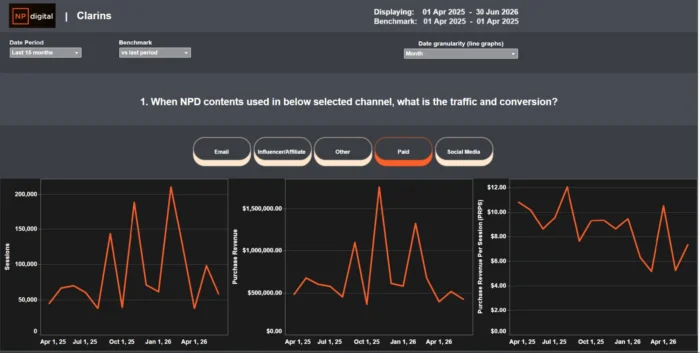
Move to email and CRO. Keyword intent data reveals what customers are actively trying to solve, faster and at greater scale than survey data or focus groups. The teams using that signal to inform email segmentation and on-page testing are seeing conversion lift that attribution models almost never credit back to organic search. If your SEO team isn’t in the room when email segments are being built, you’re leaving that intelligence on the table.
Search-backed research also sharpens digital PR and content strategy in ways that generic thought leadership can’t match. When organic data surfaces a trend before it appears anywhere else, the brands that act on it earn coverage and links that compound authority over time. That’s not a coincidence. It’s the direct result of having humans reading the signals and moving on them before the window closes.
Product and roadmap decisions round it out. Customer intent data at scale, surfaced through search, is one of the clearest signals of what the market actually wants right now. Brands feeding that data into product and content roadmaps are making faster, better-informed decisions than those working from internal assumptions alone. According to BrightEdge, 68 percent of all online experiences begin with a search engine. Your organic presence is capturing market intelligence before customers communicate it through any other channel.
The brands getting the most from their SEO programs have stopped treating organic as a standalone channel. They’ve structured it as the intelligence layer the rest of their marketing runs on. That structural decision requires a human with enough context across channels to make that connection.
The Decisions AI Isn’t Making for You
To be direct: this is not an anti-AI argument. AI tools belong in your SEO workflow. The point is to be clear-eyed about what they do and don’t do well in practice, and where human judgment is the actual differentiator.
Prioritization. AI tools surface opportunities well. They don’t know which ones align with your business goals, your margin profile, or where you’re trying to position the brand in 12 months. That call still belongs to a strategist, every time.
Competitive interpretation. Ranking data tells you what happened. Understanding why a competitor is gaining ground, and what to do about it, requires context that isn’t in the data itself. A tool shows you the movement. A strategist reads it.
Risk management. Scaling AI-generated content without strategic governance is one of the more reliable ways to create algorithmic or manual action exposure. SEO researcher Lily Ray tracked more than 220 websites that publicly identified as customers of AI content-creation and automation platforms. The pattern she documented across the sites matches what we’ve observed in competitive intelligence across our own client programs.
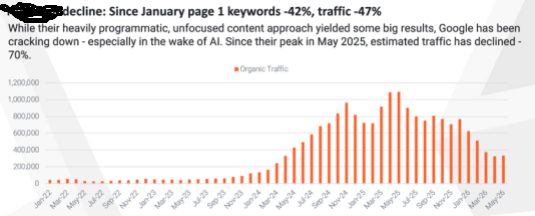
One example: a client’s competitor in the IT management software space rapidly scaled AI content, but a lot of the material didn’t have enough/strong of a purpose or tie to their core brand. At first, this seemed to pay off, with them peaking in page-one search visibility in May 2025. By mid-year, though, visibility had declined back to April 2024 levels. Ultimately, straying away from their core identity and creating content for itself was not a winning strategy for them.
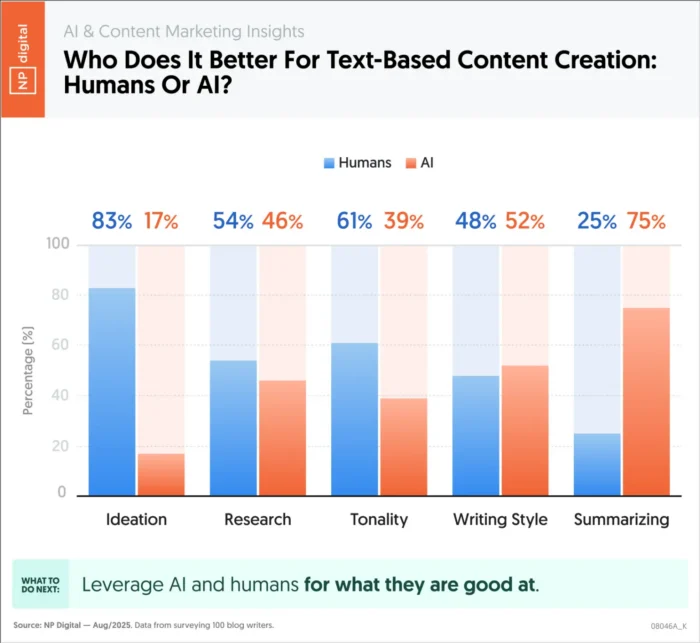
The brands that avoided that exposure share something in common. Humans are in the loop reviewing for quality, not just volume. As Lily Ray has noted in her research: “The key is ensuring AI-supported content still includes unique insights, firsthand expertise, and original perspectives that competitors can’t also copy-paste from an LLM response.”
Adaptive strategy. Algorithm updates, shifts in search behavior, and the emergence of new surfaces like AI Overviews require real-time judgment calls. Automated systems optimize for what they were configured to optimize for. They don’t recalibrate for context. A recent look at AI SEO covers how to think about where automation fits and where it doesn’t.
The Compounding Advantage of Keeping Humans in the Loop
Shifting the frame from what AI can’t do to what human-led SEO builds over time gets to the stronger argument.
Brand positioning in search is not just about rankings. Your presence across search surfaces communicates something about who you are, whether or not you’re intentionally shaping it. AI Overviews, social search, and vertical platforms are all forming impressions before a user clicks anything. Shaping that presence with coherent editorial judgment is not something you can hand off to a tool. It requires a person who understands both the brand and the audience.
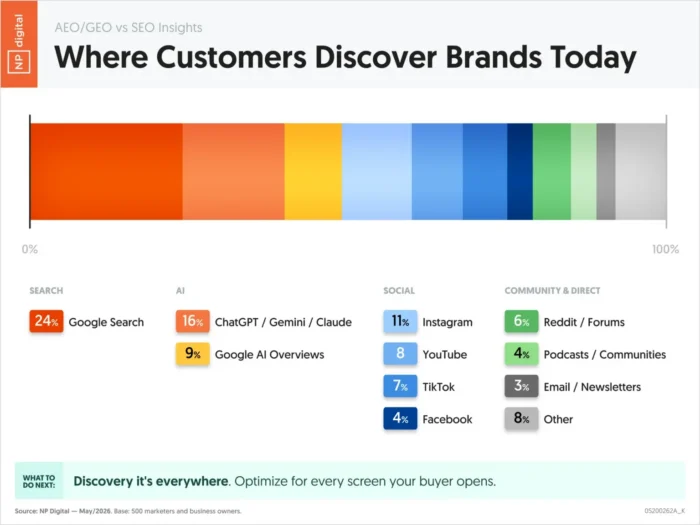
The intelligence value of SEO also compounds the longer a skilled practitioner is actively reading the signals. Customer intent data, emerging topic areas, and language shifts all surface in search before they appear anywhere else. Teams with experienced strategists interpreting that data are making decisions ahead of the market, not in response to it. That timing advantage shows up in content programs, product decisions, and competitive positioning.
Competitive advantages built through genuine expertise and consistent positioning are also harder to replicate quickly. Automated execution gets copied at scale. Judgment-driven content, built on original perspective and real domain knowledge, takes time and genuine effort to close. That gap tends to be stickier across algorithm changes than any technical edge.
The numbers support making the investment. BrightEdge research indicates that SEO drives 1,000 percent more traffic than organic social media. The programs compounding on that baseline right now are not the highest-volume publishers. They’re the ones with a strategist in charge, using search everywhere optimization as the connective tissue across channels.
FAQs
What is human-led SEO?
Human-led SEO refers to organic search programs where strategic decisions (prioritization, content positioning, competitive response, and channel integration) are made by experienced practitioners. AI tools can handle execution tasks like auditing, clustering, drafting, and analysis. The judgment layer stays with a strategist who understands both the data and the business context it’s operating in.
Does AI replace SEO strategists?
Not in the programs that are outperforming. AI accelerates execution and surfaces data at a scale no manual team can match. Interpreting that data, connecting it to business goals, and deciding what to act on still requires a human with context that tools don’t have. The two are most effective working together, with a clear boundary between what each handles.
How does scaling AI content hurt SEO performance?
Scaling AI-generated content without strategic oversight produces quality signals that search algorithms are specifically designed to detect and suppress. Google’s Scaled Content Abuse spam policy, introduced in 2024, explicitly targets content generated at volume without adding sufficient original value. The brands catching traffic declines tend to be the ones treating publication volume as a substitute for quality.
{
“@context”: ”
“@type”: “FAQPage”,
“mainEntity”: [
{
“@type”: “Question”,
“name”: “What is human-led SEO?”,
“acceptedAnswer”: {
“@type”: “Answer”,
“text”: “
Human-led SEO refers to organic search programs where strategic decisions (prioritization, content positioning, competitive response, and channel integration) are made by experienced practitioners. AI tools can handle execution tasks like auditing, clustering, drafting, and analysis. The judgment layer stays with a strategist who understands both the data and the business context it’s operating in.
”
}
}
, {
“@type”: “Question”,
“name”: “Does AI replace SEO strategists?”,
“acceptedAnswer”: {
“@type”: “Answer”,
“text”: “
Not in the programs that are outperforming. AI accelerates execution and surfaces data at a scale no manual team can match. Interpreting that data, connecting it to business goals, and deciding what to act on still requires a human with context that tools don’t have. The two are most effective working together, with a clear boundary between what each handles.
”
}
}
, {
“@type”: “Question”,
“name”: “How does scaling AI content hurt SEO performance?”,
“acceptedAnswer”: {
“@type”: “Answer”,
“text”: “
Scaling AI-generated content without strategic oversight produces quality signals that search algorithms are specifically designed to detect and suppress. Google’s Scaled Content Abuse spam policy, introduced in 2024, explicitly targets content generated at volume without adding sufficient original value. The brands catching traffic declines tend to be the ones treating publication volume as a substitute for quality.
”
}
}
]
}
Conclusion
The programs winning in organic search right now use AI to move faster while keeping humans in charge of where to go.
That distinction matters for how teams are structured and where attention should be focused. AI belongs in the execution layer: audits, clustering, drafting, performance analysis. Human strategists belong at the decision layer: determining priorities, reading competitive signals, connecting the SEO program to real business outcomes, and keeping quality standards where they need to be to hold ground over time.
At NP Digital, building programs this way is core to how we work. Ready to build a program built around strategy, not just tools? Let’s talk.