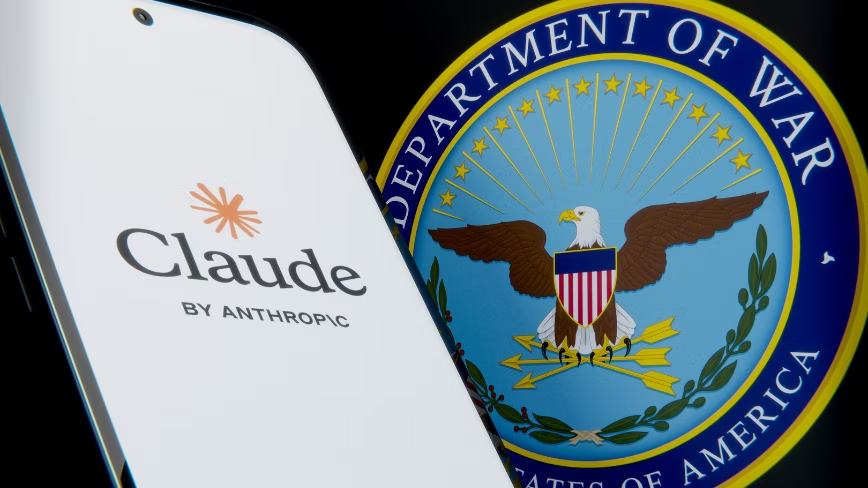
A federal judge has voided the Pentagon’s designation of Anthropic as a national security supply-chain risk, finding that the label was punishment for the company’s public criticism of the Trump administration rather than a security assessment. US District Judge Rita Lin, of the Northern District of California, issued the decision on Thursday in a 59-page order.
Lin wrote that “the empty invocation of national security is not a blank check to punish and retaliate against government critics,” as Jack Queen reported for Reuters.
The order found violations of the First Amendment and of the Fifth Amendment’s due process clause, and requires the government to withdraw the directives it issued against the company, according to Quartz.
The dispute began on February 27, when President Donald Trump instructed agencies to stop using Anthropic’s technology and Defense Secretary Pete Hegseth designated the company a supply-chain risk on the same day. The trigger, Courthouse News reported, was Anthropic’s refusal to lift two contractual restrictions on Claude: no mass surveillance of Americans, and no fully autonomous weapons.
Anthropic sued in March, calling the designation unlawful retaliation, and Lin granted a preliminary injunction later that month on First Amendment grounds. The Pentagon’s chief technology officer told Breaking Defense at the time that the ban stood regardless, which is roughly where the case has sat since.
Thursday’s order resolves cross-motions for summary judgment heard on July 30, when Lin was already sceptical of the government’s record. “I don’t see additional evidence from the government really justifying what it did,” she said at that hearing, according to Axios. “If anything, it seems like the record, in some ways, has gotten worse for the government.”
Her written ruling goes further, concluding that the measures were driven by a wish to make an example of Anthropic for its “arrogance,” and that the Pentagon could not impose sweeping penalties on the basis of the company’s critique of administration policy.
Lin also noted the awkward fact that the military kept trying to work with Anthropic while calling it a security risk, a pattern visible elsewhere in the administration’s dealings with the company.
The Justice Department had argued that the designation grew out of a contractual disagreement rather than Anthropic’s views, and that the company’s usage limits left the military with operational uncertainty. The government has signalled it will appeal.
An Anthropic spokesperson said the company remains “focused on working productively with the government to harness AI for our national security,” in a statement given to Axios.
A second front is still open. Anthropic is separately challenging a designation covering civilian government contracts in Washington, DC, where the appeals court declined to grant emergency relief in April, reaching a different conclusion from Lin’s on much the same conduct.
For European buyers watching how far a government can go in punishing a model provider over its safety terms, that split is the part worth following. Lin has not set a date for further proceedings, and the government has not said when it will file its appeal.