Key takeaways
- Substack is a publishing platform that combines blogging and email newsletters with paid subscriptions, giving creators and brands a direct line to their audience without relying on algorithms.
- It’s free to publish on Substack. The platform takes 10% of revenue only when creators charge for paid subscriptions, plus Stripe processing fees.
- Substack has evolved beyond newsletters. It now supports podcasts, video, a social feed called Notes, group chats, and a recommendation network, making it part publishing tool, part social platform.
- Businesses are using Substack to build trust, share thought leadership, and create direct relationships with customers outside of social media algorithms.
What is Substack?
Substack is a publishing platform that acts as a content hub and email newsletter delivery system while letting creators monetize their work through subscriptions.
Substack lets writers and creators distribute content directly to their audiences. The type of content can be:
- Articles,
- essays,
- podcasts and other audio, and
- videos.
Substack is unique in its functionality. It combines publishing and email delivery with a subscription layer:
- Publishing platform: Creators can easily write, create, and publish content that lives on Substack’s public-facing website. Readers can browse free content much like any blog or online magazine.
- Email delivery system: Unlike traditional blogs, every new post can also be delivered directly to your email list, tapping into 4.6 billion email users worldwide. This bridges the gap between open web publishing and direct inbox communication. Newsletter subscribers never miss an update, and writers have a built-in distribution system.
- Subscription features: Substack lets creators offer free or paid subscriptions. Paying subscribers can unlock premium content while free subscribers only get access to public posts. Substack handles payments and subscriber management along with analytics, so creators can focus on their content. The paywall is optional, of course.
Substack originally started out as a simple newsletter platform loved by bloggers. But it’s evolved into something useful for marketers and brands. Now, it’s one of the new social media platforms professionals are flocking to.
Substack is different from traditional corporate blogs, newsletters, and in-app platforms because of its:
- Direct-to-audience model that doesn’t rely on SEO, social media, or ads.
- Dedicated site for each newsletter publication, so content is archived and accessible.
- Social features like Substack Notes and discussion threads for community interaction and recommendations.
- Subscription model that sends revenue straight from the audience to creators.
A brief history of Substack
Substack launched in 2017, founded by Chris Best, Hamish McKenzie, and Jairaj Sethi in San Francisco. The idea was simple: give independent writers a way to run a paid newsletter without wrestling with separate tools for publishing and email delivery, plus payment processing.
Early on, Substack found its audience among independent journalists and writers who wanted to own their relationship with readers instead of publishing inside someone else’s platform. From there, it kept adding features that pushed it well beyond a plain newsletter tool.
A few key milestones along the way:
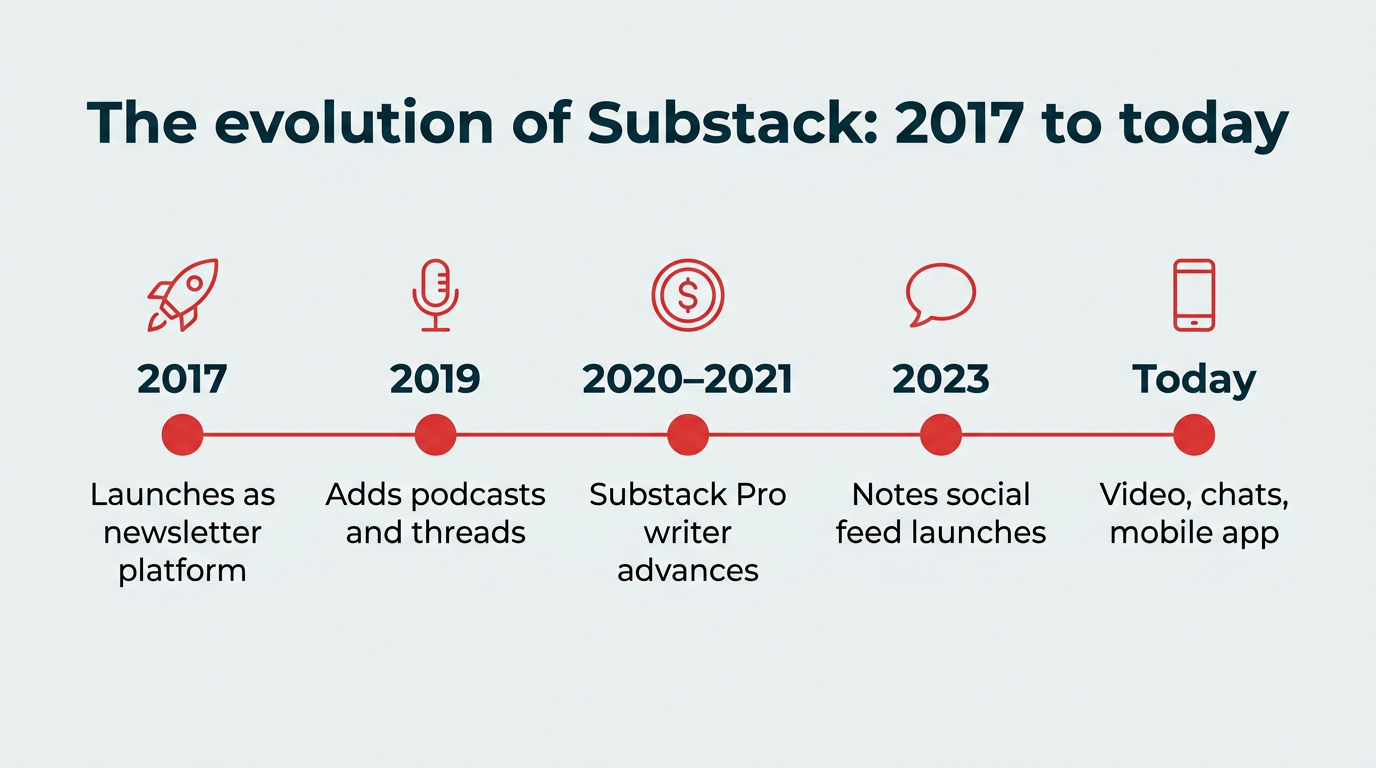
- 2017: Substack launches as a subscription newsletter platform.
- 2019: Podcast support and discussion threads are added. Substack also begins offering fellowships with stipends to select writers.
- 2020–2021: Substack Pro begins offering larger advances to attract high-profile writers.
- 2023: Substack Notes launches, adding a short-form social feed to the platform.
- Recent years: Video support, group chats, and a growing mobile app have turned Substack into a full media platform used by millions of readers.
How does Substack work?
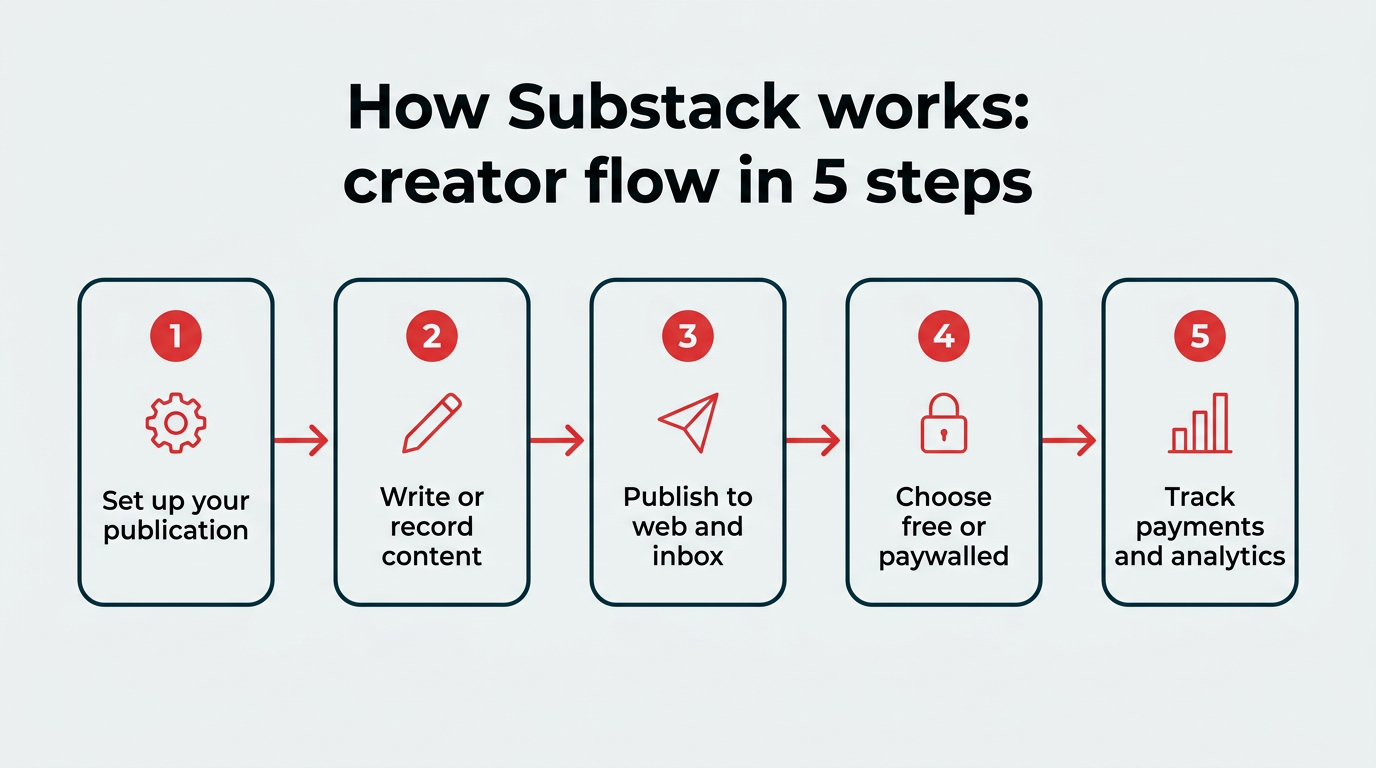
Substack works by combining a publishing tool and an email service with a payment system into one flow. Here’s how it works for a creator:
- You sign up and set up a publication with a name, logo, and description.
- You write or record content using Substack’s built-in editor.
- Your content is published on the web and delivered to subscribers’ inboxes at the same time.
- You choose whether each post is free or behind a paywall for paid subscribers.
- Substack handles payments and subscriber management along with analytics, so you can focus on the content.
Readers can follow along on the web or through the Substack app, which pulls together all the publications they subscribe to in one feed.
For expert Substack advice, we spoke to Omobolaji Ajibare, the Chief Content Officer of TheSocialMediaOga. Ajibare has thousands of subscribers and uses Substack as one tool in her digital marketing strategy.
“I use Substack as an extension of my work as a Social Media Manager, Mentor, and Content Creator,” says Ajibare. “My newsletter, The Social Media Manager Bible, is where I break down strategies, case studies, tools, and lessons that don’t always fit neatly into Instagram carousels or YouTube videos.”
Key features of Substack
Substack packs a lot into one platform. Here are the main features grouped by what they help you do.
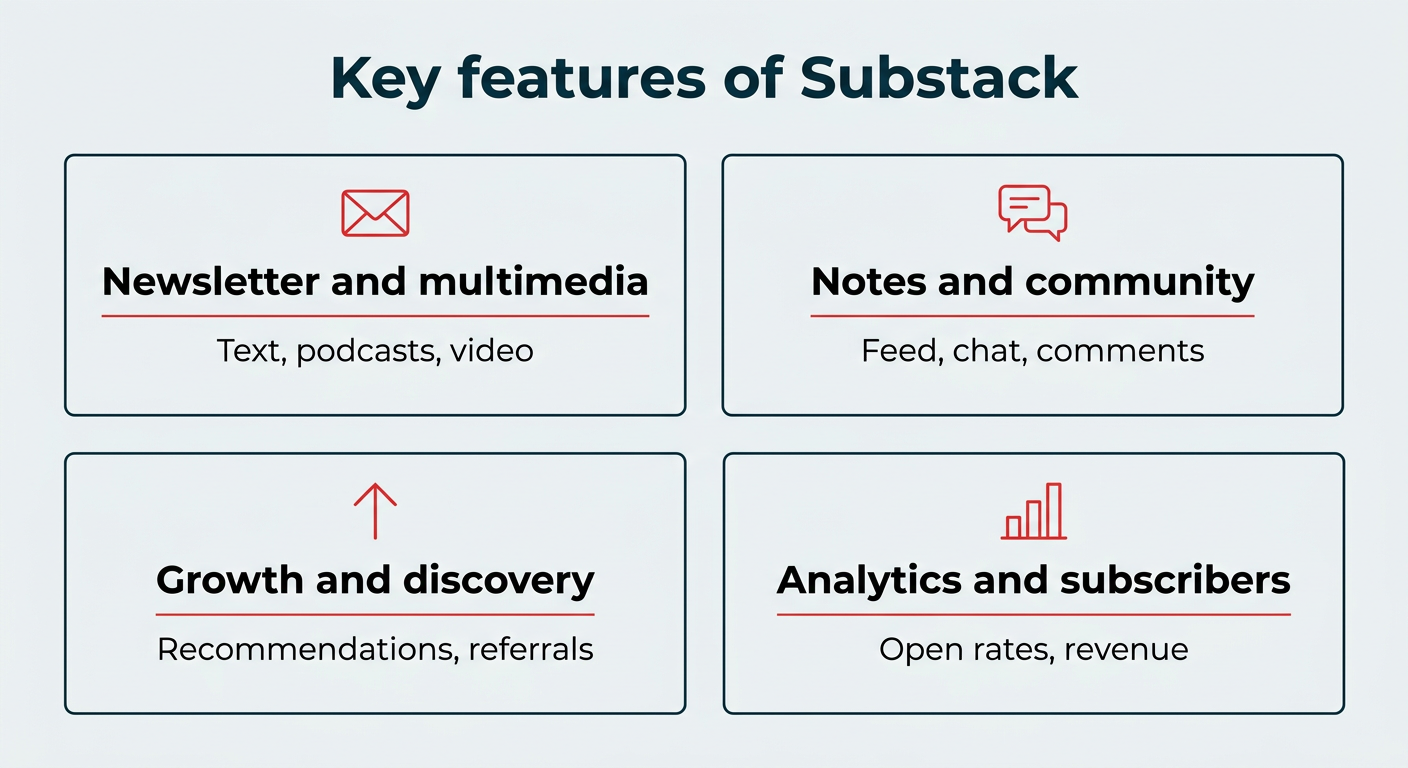
Newsletter publishing and multimedia
At its core, Substack is a newsletter publishing tool. The built-in editor gives you formatting options and scheduling with email delivery, and every post lives on the web while landing in subscribers’ inboxes at the same time.
Beyond text, you can host podcasts, embed video, and share audio. That makes it easy to tell a story in whatever format fits, without stitching together separate tools.
Substack Notes and community features
Substack Notes is a short-form social feed inside Substack, similar to X (formerly Twitter). Creators and readers can share brief posts, links, quotes, and images, and it’s a big reason people now ask whether Substack counts as a social network.
On top of Notes, you get comments on every post and Substack Chat for group conversations. A recommendation network lets creators point readers toward each other’s publications.
Growth and discovery tools
Substack has several features built to grow your audience. The recommendation engine, Substack Boost, referral programs, and the app’s discovery feed all help new readers find your work. It also helps that millions of readers with credit cards on file already exist in the ecosystem, looking for newsletters to subscribe to.
Analytics and subscriber management
Substack includes built-in analytics for open rates and subscriber growth, plus revenue tracking and tools to manage your subscriber list. Be aware that these are more basic than what you’d get from a dedicated email marketing platform.
Ajibare says the ability to create sections and series is a key feature for her brand. “For example, I can run a series on analytics, then another on creator marketing, and readers can easily go back and binge everything. It’s like organizing my library of knowledge in public.”
How much does Substack cost?
Substack is free to publish on, and it doesn’t charge anything for free newsletters. It only takes 10% of revenue when you charge for paid subscriptions.
Similarly, Substack is always free for readers; they only pay for the subscriptions they sign up for.
Source: Substack
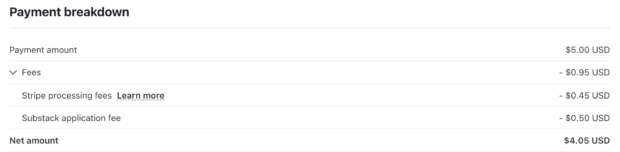
For creators, you can also expect to pay fees to Stripe for any credit card transactions made by your subscribers. Even if your subscribers choose to pay with other methods, like direct debit, you’ll still pay a Stripe fee. The amount depends on the country where you registered your account.
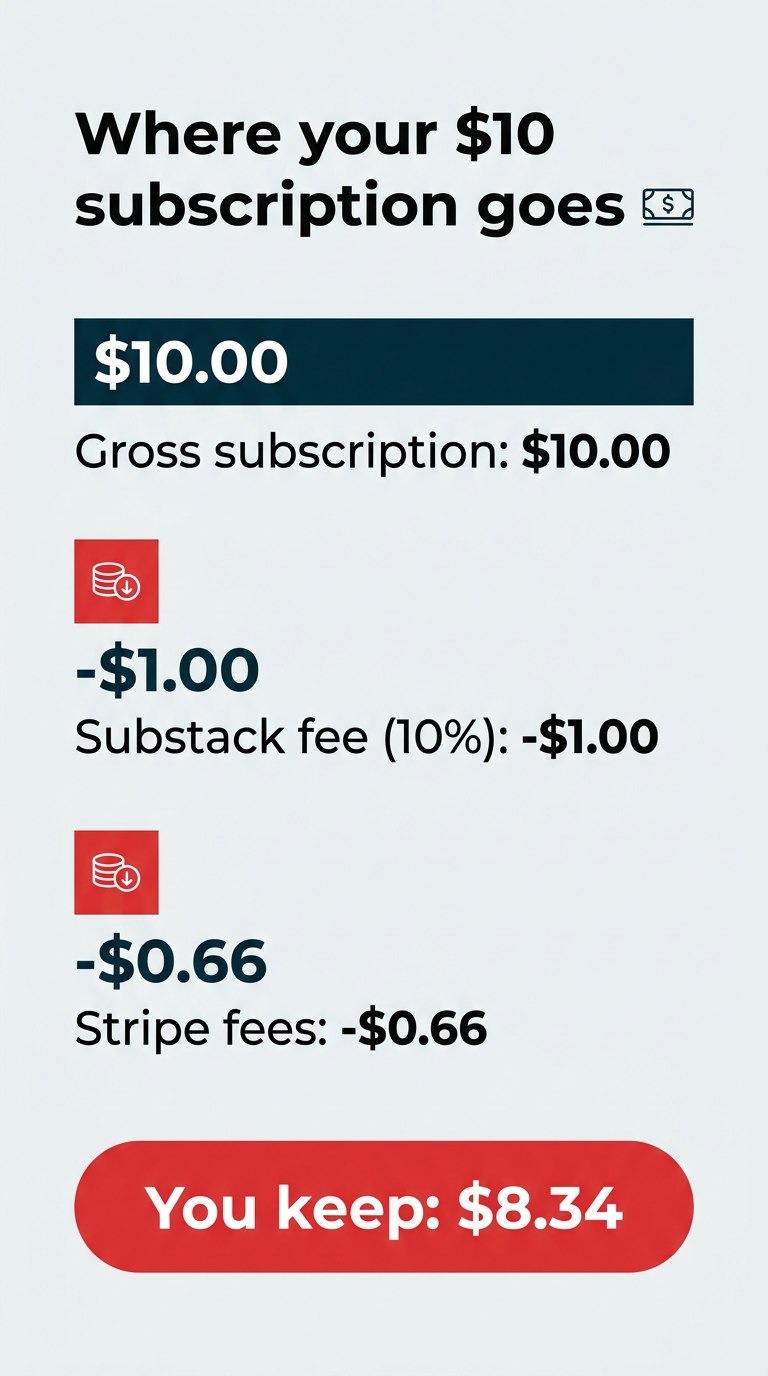
Hypothetically, let’s say you set your paid newsletter subscription at $10/month. Substack takes 10%, so $1.00 per subscriber. Stripe’s standard for U.S. cards is 2.9% + $0.30 per transaction, plus a 0.7% billing fee for recurring payments. So 2.9% of $10 = $0.29, plus $0.30 flat fee, plus 0.7% of $10 = $0.07. Your total Stripe fee = $0.66.
$10.00 – $1.00 (Substack) – $0.66 (Stripe) = $8.34 net subscription revenue per sign-up. If you have 1,000 subscribers, you’ll see $8,340/month.
That all being said, other payment methods (like iDEAL or SEPA) are different, and failed or disputed payments can carry extra costs.
Who uses Substack?
Anyone who benefits from direct communication and storytelling with an audience can use Substack. The platform serves purposes beyond marketing alone. The main users fall into a few groups.
Writers, journalists, and creators
Independent writers and journalists are Substack’s original and largest user base. Podcasters and video creators have followed, along with educators, using the platform to publish their work and earn directly from readers instead of chasing ad revenue or platform payouts.
Businesses and brands
More and more businesses are realizing the potential of Substack, given that 35% of college graduates get news from email newsletters. Instead of relying on algorithms or third-party platforms, businesses own their subscriber list hosted on Substack and send content directly to it.
Fashion brand Tory Burch, for example, runs a Substack called What should I wear? that gives readers a look behind the scenes of the fashion world. And Aleen Dreksler, the CEO of Betches, runs Please Advise, where she shares long-form business and life advice in a relatable voice.

Source: What Should I Wear
Businesses use Substack for thought leadership, customer education, employer branding, and direct audience relationships. It can complement a social media marketing plan rather than replace it.
“Unlike Instagram or TikTok, where I’m at the mercy of algorithms, Substack puts me directly into someone’s inbox,” says Ajibare. “That intimacy matters when you’re teaching, because you’re not just chasing views; you’re nurturing a dedicated community of learners.”

Source: The Social Media Manager’s Bible
“Whether you’re a brand or an individual, Substack works when you stop thinking of it as content marketing and start thinking of it as community-building,” says Ajibare.
How businesses use Substack to generate value
The Substack website is for “any business that wants to build depth, not just reach,” says Ajibare.
Shift from promotion to thought leadership
“Enterprise teams sometimes overlook the fact that people are tired of being marketed to all the time,” says Ajibare. “Substack offers a chance to have conversations, share insights, and position your brand as a trusted guide rather than just a seller.” And niche marketing is one of this year’s biggest social media trends.
Build direct relationships with your customers
Forget chasing engagement through social media algorithms. Substack delivers your content straight to subscribers’ inboxes, creating a direct, high-value connection with your most loyal audience. Pair it with social listening to identify what topics your subscribers care about most.

#1 Easy Social Listening
Brand mentions, trending topics, and sentiment at your fingertips. Enhance your social strategy with the insights that matter.
Build trust through dialogue
Your newsletter can become a living hub for ideas, updates, and reflection. Use it to invite responses, start discussions, and cultivate an informed community around your brand values.
Lean into being unpolished
Whether you’re sharing campaign lessons or leadership reflections, authentic storytelling helps your brand stand out. “You don’t have to produce perfect essays,” says Ajibare. Substack rewards honesty and depth, two things audiences rarely get from corporate blogs.
Pros and cons of Substack
|
Pros |
Cons |
|---|---|
|
Free to publish, with no upfront cost to start. |
Limited customization compared to enterprise tools. |
|
Built-in distribution and a direct relationship with your audience. |
You pay a 10% fee plus Stripe fees on paid subscriptions. |
|
Supports multimedia (podcasts, video, audio) and community engagement. |
Discovery still depends, in part, on external promotion. |
|
Millions of readers with credit cards on file are already in-app, looking to subscribe. |
Fewer email marketing features than dedicated email tools. |
|
Recommendation network and referral tools help new readers find you. |
Content is not strictly moderated, so branded content could appear near controversial material. |
|
Substack Notes, Chat, and comments add social and community layers. |
Analytics and reporting are basic. |
|
Easy-to-use app on iOS and Android. |
You own your audience data, but it’s hosted on Substack, which can change its rules. |
Content moderation and controversies
Content moderation is the most common criticism aimed at Substack. Because the platform takes a hands-off approach, some creators have publicly left over its decisions not to remove certain controversial publications.
For brands, the practical takeaway is that Substack’s recommendation network and open feed mean your content can sit alongside material you wouldn’t choose to be associated with. It’s worth weighing that against the platform’s reach before you commit.
Substack vs. other platforms
Substack isn’t the only way to publish and monetize content online. Here’s how it compares to a few common alternatives, so you can see where it fits.
Substack vs. other publishing platforms
|
Criteria |
Substack |
Medium |
WordPress |
LinkedIn Newsletters |
Ghost |
|---|---|---|---|---|---|
|
Cost model |
Free to publish, 10% of paid subs |
Free; paid membership option |
Free software, paid hosting |
Free |
Paid hosting or self-host |
|
Audience ownership |
You own the subscriber list |
Medium controls reach |
You own everything |
LinkedIn owns the audience |
You own the subscriber list |
|
Monetization |
Paid subscriptions built in |
Partner Program payouts |
DIY via plugins |
None native |
Paid subscriptions built in |
|
Customization |
Limited |
Very limited |
Extensive |
Very limited |
Extensive |
|
Community features |
Notes, Chat, comments |
Comments, claps |
Via plugins |
LinkedIn feed and comments |
Comments, memberships |
|
Multimedia |
Podcasts, video, audio |
Text-focused |
Full support |
Text and images |
Full support |
How to start a Substack for your brand (step-by-step)
Before you start with Substack, you’ll want to define your content strategy. Are you interested in posting thought leadership, industry insights, or culture content?
Making a content creation strategy will give you a clear path forward on what you’re going to publish on Substack.
Once you’re ready, here’s the Substack step-by-step:
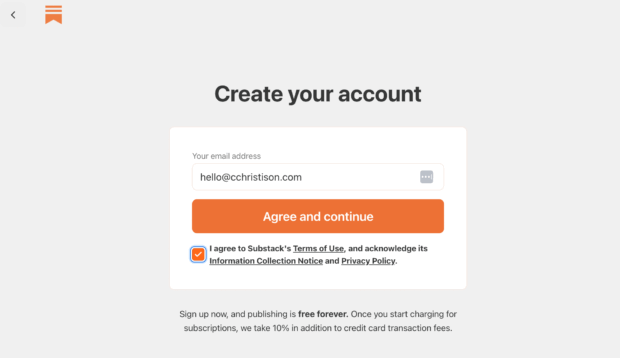
Sign up and create a publishing profile.

Sign up with your email, then choose a username.
Upload any mailing lists you’ve got.

Add subscribers. If you have anyone you would like to invite to your Substack, now’s the time to add their emails.

Add like-minded publishers to your recommendation list to grow your Substack ecosystem.

Click on Set up the basics and add your brand name, description, and logo.


Head to your Settings (found on the left menu on the home page) and try to fill in as much information as you can.

Within Settings on the left menu, you’ll find subheadings like ‘Appearance‘ where you can tailor your Substack appearance to your brand. And under ‘Content‘, you can customize your automated emails to reflect your brand voice and values.
Head back out to your dashboard. Further customize your Substack to reflect your brand colours, font, and other visual identity bits under Creator Settings → Branding on the left menu. You’ll also see the option for Homepage, which allows you to tailor your style and layout for your Substack homepage.

Back at your home dashboard, click on Payments (from the left menu, under Creator Tools). In this tab, you can set up your Stripe account so subscribers can give you money.

Then, it’s as simple as hitting that giant, orange Create new button and publishing your first post. Be sure to promote it on your social channels!

Then, the only thing that’s left to do is to track your analytics and refine your strategy over time.
Substack best practices for 2026
1. Show up consistently
Many creators launch a newsletter with excitement, post twice, then vanish. And readers notice,” says Ajibare. “Substack requires you to treat your audience like a relationship. If you only show up when you need something, the trust breaks.“
Pick a cadence you can sustain and stick to it. Consistency signals reliability and builds long-term loyalty.
2. Get specific
Skip vague thought pieces. Focus on niche, actionable content ideas your audience can use right away. Think of detailed how-tos, case studies, or campaign breakdowns.
3. Repurpose what works elsewhere
Transform high-performing social posts, webinars, or internal insights into long-form newsletters. It’s a smart way to deepen your existing content without doubling your workload.
“A lot of creators feel overwhelmed by yet another platform,” says Ajibare. “But Substack doesn’t have to be extra work. You can take what’s already working for you on other platforms and expand it here.”
4. Avoid the sales trap
Your readers came for insights. Lead with useful stories and lessons. Sprinkle in promotion sparingly.
“Substack readers are not looking for ads disguised as newsletters,” says Ajibare. “They’re looking for insights, stories, and real value. If every post feels like a sales pitch, people unsubscribe. My advice is simple: give 80 percent value, 20 percent promotion.”
5. Define your voice early
“Substack works when you sound human. Don’t try to be overly formal or corporate,” says Ajibare. “Decide what your unique perspective is and build from there.”
Whether your tone is bold, conversational, or analytical, stay consistent. Readers will subscribe for your perspective, not your polish.
6. Play the long game
“Substack isn’t about instant virality,” says Ajibare. “It’s about compounding trust. Even if you only have 50 subscribers at the start, that’s 50 people who gave you direct access to their inbox.”
7. Don’t underestimate the power of structure
“Create series, themes, or recurring segments,” says Ajibare. “That makes your content easier to follow and gives people a reason to come back.”
FAQ: What is Substack?
What do people use Substack for?
People use Substack to publish and distribute content to an audience, either for free or on a subscription model. Writers, journalists, podcasters, educators, and businesses all use it to build a direct relationship with readers.
Is Substack free to use?
Yes, Substack is free to use. Publishing is free, and reading free content costs nothing. Paid subscriptions incur a 10% Substack fee plus Stripe processing fees.
What is the downside of Substack?
The main downsides are limited customization, few email marketing features, subscription fees, loose content moderation, and basic analytics. If you’re looking for enterprise-level capabilities, you’ll find Substack pretty basic.
Can you read Substack for free?
Yes, Substack has a free, public platform for readers. You can browse and read free content on the web or through the Substack app without paying anything.
Can companies use Substack for marketing?
Absolutely. Companies use Substack to humanize their marketing and build communities while sharing long-form content. It’s a strong fit for thought leadership and community-building, and some brands use it to generate revenue through subscriptions.
How do businesses make money on Substack?
Businesses make money on Substack mainly through paid subscriptions. They can also use free newsletters to drive traffic to other revenue streams and explore sponsored content opportunities with their audience.
Why is everyone leaving Substack?
Some creators have left Substack due to concerns about its content moderation policies, particularly its decision not to remove certain controversial publications. It’s worth noting that many creators stay and grow on the platform, so “everyone leaving” overstates the picture.
How is Substack different from Medium?
Substack focuses on email-delivered newsletters with direct subscriber relationships and optional paid subscriptions. Medium is a shared publishing platform where content is surfaced through Medium’s own recommendation algorithm and paywall, so you don’t own the audience the same way.
What is Substack Notes?
Substack Notes is a short-form social feed within Substack where creators and readers share brief posts, links, quotes, and images, similar to X (formerly Twitter). It’s one of the features that makes Substack feel like a hybrid of publishing tool and social network.
Can you make a living on Substack?
Yes, thousands of creators earn a full-time living on Substack through paid subscriptions. Income varies widely based on niche and audience size, so results are far from guaranteed.
Save time managing your social media marketing strategy with Hootsuite. Publish and schedule posts, find relevant conversions, measure results, and more â all from one dashboard. Try it free today.